Home > Broadband > Broadband Guides > FTTP vs FTTC
What's The Difference Between FTTP vs FTTC
Find Out Which Is Best For You
Written by Simon Thompson, Telecom Services Director
20 May 2025 - Have you ever looked at your broadband bill and wondered what all the acronyms and technical terms mean? From Kb to Gb internet speeds to FTTP and FTTC, it can get pretty confusing.

Not all connections are as efficient at getting you online, so we’re here to explain the difference between FTTP and FTTC, how they work, and what they mean for the quality of your broadband.
What is FTTC (fibre-to-the-cabinet)?
FTTC stands for fibre-to-the-cabinet and is a method for distributing fibre broadband, also called fibre optic or part-fibre broadband.
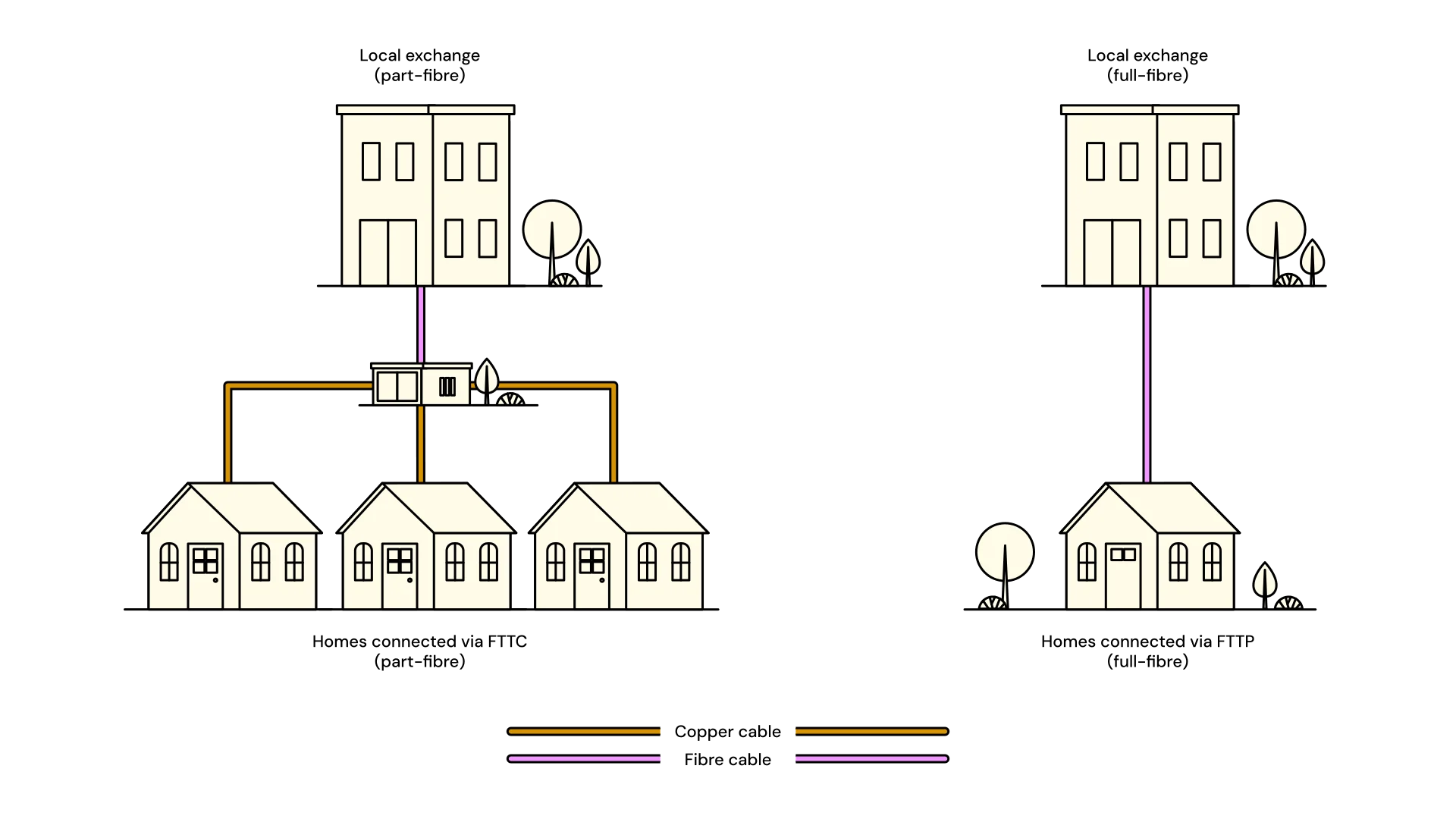
It works using fibre optic cables that run from your exchange to your local street cabinet, which could be a green box on your street. Copper cables then connect from there to your home.
This mix of fibre and traditional copper wires means you can access faster speeds than traditional broadband, which only transmits data through older copper phone lines. These wires, also called Asymmetric Digital Subscriber Lines (ADSL), are more fragile and vulnerable to damage and also can’t pass as much internet data as quickly – which is where FTTC came in.
Fibre-to-the-cabinet was introduced to keep up with our increased broadband usage and need for faster internet speeds, but times change quickly, and we soon needed an even quicker and more efficient solution.
What is FTTP (fibre-to-the-premises)?
FTTP is short for fibre-to-the-premises and is the next evolution in how we connect and receive internet data – and you might also know it as Full Fibre broadband. That’s because it uses only fibre optic cables that send data directly from the broadband exchange to your home or office, skipping any old copper phone lines which slow the process down.
As this method skips the older copper wires and transmits data directly using the more advanced fibre-optic wires, FTTP broadband is one of the fastest, most powerful, and most reliable connections available on the market.
The only drawback is that because the technology is so new and involves a lot of work to install the fibre optic wires that lead to our homes, it’s not as widely available as fibre-to-the-cabinet. While it’s gradually being installed in more and more areas in the UK, its coverage is often limited to bigger towns and cities.
Openreach, CityFibre and other alternative network providers are working to make FTTP accessible to the UK, and as of January 2025, Full Fibre broadband is available in 74% of UK properties according to Ofcom.
What speeds can I get with FTTC and FTTP?
Thanks to the all-fibre cables that power FTTP connections, fibre-to-the-premises easily offers much faster speeds than its copper wire FTTC counterpart, which is one of the biggest deal-breakers when it comes to choosing between the two.
FTTC can offer average download speeds of 35–63Mbps, depending on your broadband package and provider. These speeds are perfectly fine for everyday internet use, like streaming standard-definition videos, online gaming, and general browsing, but may struggle if you need a bit more power. Plus, your actual speed will be affected by the quality of the copper line from the cabinet to your home and your distance from the cabinet.
So, how much faster is fibre-to-the-premises?
FTTP can deliver speeds much higher than FTTC, typically starting around 100 Mbps and going up to 1 Gbps or more. This makes it much better for high-definition video streaming, high-speed gaming, extensive file downloads and uploads, and heavy simultaneous usage across multiple devices. And unlike FTTC, FTTP isn’t affected by distance from the cabinet or the quality of old copper lines, giving you a more consistent and reliable connection.
At UW, we offer fibre broadband deals with average download speeds of 35–63Mbps and Full Fibre packages with speeds of up to 944Mbps. Find out more about our broadband packages and get your quote here.
FTTC vs FTTP: which is better?
Both FTTC and FTTP have their own benefits, so which is right for you? Let’s look at their pros and cons in a bit more detail to help you work out the best one for your needs:
FTTC | FTTP | |
Connection Type | Uses a combination of fibre optic cables to a local cabinet and then copper wires to your home. | Offers a direct fibre optic connection to your premises. |
Connection Speed | Speeds can reach up to around 80 Mbps. | Delivers potential speeds of up to 2 Gbps. |
Installation | Uses existing copper phone wires, so no infrastructure changes are needed to connect to homes. | Requires an engineer to run a fibre optic cable from a telegraph pole or underground to a property. |
Availability | Very widely available. | Currently available for just under three-quarters of homes in the UK and expanding. |
Reliability | While reliable, it is more prone to dropouts and cannot handle demands or higher internet speeds or traffic. | Very reliable, less susceptible to dropouts, and better suited to faster speeds. |
Futureproof | Moderately, but restricted by copper wire limitations. | Yes, it’s much more likely to handle future broadband advances without the need for significant infrastructure changes. |
Cost | Tends to be more affordable. | Full Fibre broadband deals can be more costly. |
Should I get FTTP or FTTC broadband?
Deciding whether fibre-to-the-premises or fibre-to-the-cabinet broadband is best for you depends on things like your usage, the number of people who’ll be using the internet, and its availability in your area. Here are a few pointers to help you choose:
Choose FTTC if:
You’re mindful of budget and need something more cost-effective. FTTC offers a significant upgrade from standard ADSL connections without the higher price tag of FTTP.
Your internet usage generally includes light web browsing, streaming at standard definitions, and regular daily use without needing intensive bandwidth. FTTC could be enough for you.
FTTP hasn’t yet been rolled out in your area, but FTTC is the next best high-speed broadband option.
Choose FTTP if:
You need ultra-fast internet speeds for streaming videos in 4K, gaming online, or you often download and upload large files.
You have a lot of users or devices connected to the internet in your household at the same time.
You want to invest in a long-term solution that can keep up with newer broadband advances.
Head over to our guide on which broadband speed you need for more help choosing between FTTC and FTTP.
Do I have FTTP vs FTTC?
If you’re thinking about upgrading your broadband deal, knowing what type of connection you currently have can give you some clarity on what options are available to you. But how can you tell whether you’re serviced by fibre-to-the-premises or fibre-to-the-cabinet?
Here are a few ways to work out which connection you have:
Log into your broadband account via your internet service provider (ISP) — You may be able to find out everything you need by logging into your account and scanning through your account settings.
Check your broadband bill – Some ISPs will list your connection type on your monthly bill. Look at what plan you’re on; if it’s a Full Fibre broadband deal, you’re likely serviced by FTTP, whereas traditional broadband and fibre broadband tend to use FTTC.
Use a broadband checker tool – You can also use Ofcom’s broadband availability checker to see what kinds of connections are available in your area.
FAQs
Yes, you can upgrade from FTTC to FTTP, but only if it’s available in your area. You can learn more about how to check your full-fibre availability here.
If your address is full-fibre-ready, you can explore our FTTP broadband deals here.
FTTH stands for fibre-to-the-home and is another name for fibre-to-the-premises (Full Fibre), as both use fibre optic cables to send broadband data directly from the exchange to our home. So, whenever you see FTTH, it’s referring to the super-fast Full Fibre broadband connection.
As part of the Full Fibre rollout, the copper wires used for FTTC are gradually being replaced because they’re just not as efficient or reliable.
This is known as the Public Switch Telephone Network (PSTN) switch-off, where traditional landlines are going to be phased out and digital services used instead. The deadline for the PSTN switch-off is the 31st January 2027. FTTC will still be available – especially in areas where rolling out FTTP is trickier, but making telephone calls will change. Instead of calls being made over traditional landlines, they will be made over your internet service using a technology called VoIP (Voice over Internet Protocol).
Related Guides

Why is my internet so slow?
A slow internet connection can bring your day to a frustrating halt. Whether you’re faced with endless buffering or a web page that won’t load, it can be hard to know exactly why your broadband is crawling at a snail’s pace.

A Complete Guide to Broadband Speed
With more people than ever working from home, and with most of us using several devices at once, having a strong internet has never been more important.